
 There’s a good chance that many of us enjoy music in any of multiple forms. It could be rock, country, metal, jazz, hip-hop, classical, folk – whatever our preferred genres might be, we just know we like the sound.
When we hear a song we really like, we might tend to turn it up. We also may not tire of it no matter how often we hear it.
The best HVAC messages are much like favorite songs for mindful, cost-saving homeowners in Oswego, Yorkville, Naperville, Aurora and Plainfield (IL). You welcome them when you hear them because you know they offer something you appreciate.
Here at Air Dynamics, one message we like to play and repeat near the end of each summer is that now – late summer and early fall – is an ideal time for scheduling furnace maintenance.
Just like certain aspects combine to make a great song, so do particular benefits blend to give your heating system a noteworthy advantage with an inspection and cleaning at an optimal time.
Furnace Maintenance: Why August & September?
Your furnace has been dormant for several months during the cooling season, which typically peaks between June and August. This dormancy can sometimes develop potential points of system failure that a professional inspection can diagnose.
The following are some of the components that can potentially underperform after a long seasonal hiatus.
| Component | Developed Problem |
| Circulation pump | Seizure from months of inactivity |
| Ignition | Exhaust-gas recirculation during heating-season start-up |
| Burners | Rust and corrosion on surfaces from summer humidity |
| Flame sensors | Contamination build-up during the off-season |
| Condensate drain | Water back-up from evaporation and accumulation of debris & organic growth |
| Induced draft motor | Moisture infiltration, thickening of bearing lubricant |
| Control board | Failure after power surges during summer storms |
Furnace maintenance before the peak heating season allows you to ensure your system has a clean bill of operational health while avoiding the hassles and risks of waiting until winter.
By arranging furnace maintenance in late summer or early fall, conscientious and proactive homeowners in Oswego, Yorkville, Naperville, Aurora and Plainfield can:
catch issues before you need heat every day. A furnace that needs parts or repair in winter can leave little room to act. It also might find itself needing emergency service at a potentially higher cost.
comfortably skirt the seasonal rush. Furnace service for Oswego, Yorkville, Naperville, Aurora and Plainfield typically gets only busier once the Illinois cold arrives.
Data shows that October and November are the busiest furnace-maintenance months. The highest average rates of annual heating-system failures occur in December and January.
Scheduling your maintenance early fits it into a swifter and more-flexible service calendar. You also have less to worry about for any furnace parts that might be on back order or that require time to ship.
improve system efficiency. A cleaned and tuned-up furnace will make better use of its energy source (gas or electric).
extend the life of your furnace. Replacing a furnace in Oswego, Yorkville, Naperville, Aurora or Plainfield now averages between $4,000 and $6,000 with the potential to be even higher. The longer you can keep your furnace healthy and performing, the better. You can support that goal each year for a fraction of the cost of a system replacement.
verify system safety. Beyond keeping you comfortable and warm in the cold, a properly maintained furnace will help to avoid gas leaks, combustion issues and carbon-monoxide risks.
In essence, when you schedule furnace maintenance with time to spare, you start the season with a heating system that is safe, reliable and performing at its optimal level.
The Top-to-Bottom Furnace Physical
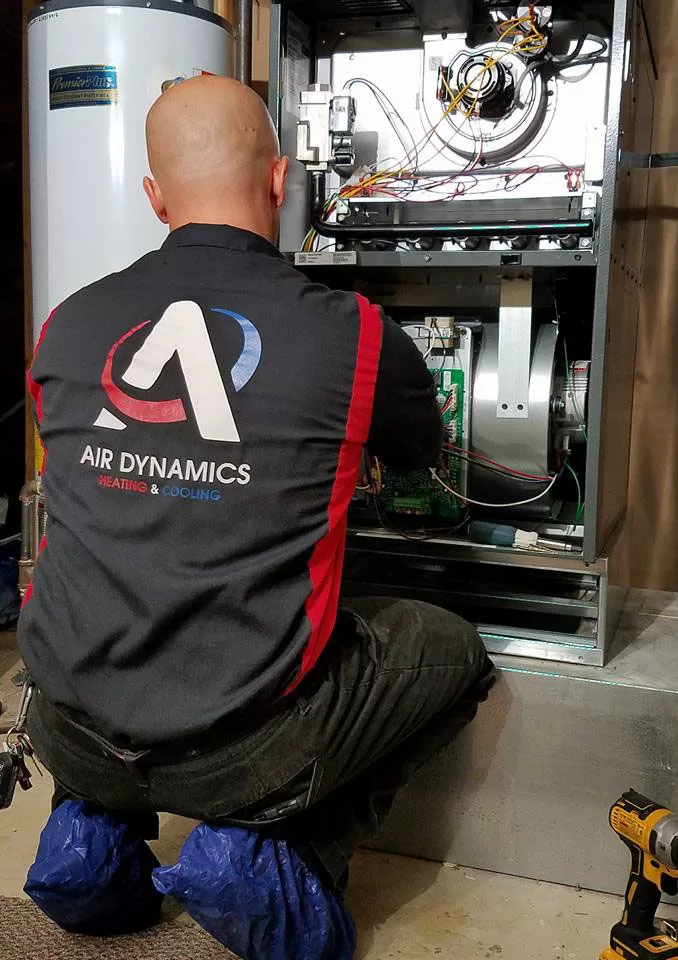
Scheduling maintenance with Air Dynamics is like having a head-to-toe physical exam for your furnace.
The following are just some of the items we inspect when we examine your furnace for mechanical health.
Safety
- Inspect heat exchanger for corrosion or cracks (to prevent carbon monoxide leaks)
- Test carbon-monoxide levels in the exhaust and the living spaces
- Check gas connections for leaks (if furnace is propane or natural gas)
- Inspect flue/venting system for blockages or risk of backdraft
Performance & Efficiency Checks
- Clean or replace air filter (if needed)
- Test the ignition system (spark or hot-surface igniter)
- Calibrate the thermostat to ensure temperature accuracy
- Check the blower motor & fan for proper airflow and smooth operation
- Lubricate moving parts as needed
Cleaning & Preventative Work
- Vacuum dust/debris from the burners, blower compartment and surrounding area
- Clean the burners to ensure even flame and efficient combustion
- Inspect, tighten and test the electrical connections
- Check the condensate drain to prevent blockages and leaks
Test Run
- Run the system through a full cycle to confirm proper start-up, heating and shut-down
- Measure the temperature rise across the heat exchanger to verify efficiency
Heating Is Communication
When we say communication, we obviously mean that the more you communicate with your heating-system professionals, the better and less expensive your furnace operation can be.
The communication also includes what your furnace may at times try to tell you in a language of its own. It’s one you can easily interpret simply by being alert to any signals the system might be sending.
The following are a few ways your furnace will tip you off to what it needs to continue working its best for you. They also are symptoms you can help to avoid by scheduling maintenance at an ideal time in your home-heating strategy.
| Furnace Problem | System Language Used |
| Ignition issues | No heat, clicking, pilot light is out |
| Thermostat malfunction | Furnace not responding or not achieving set temperatures |
| Ductwork | Cold spots in living areas, spike in energy consumption |
| Loose components | Squeaking, banging, rattling, squealing |
| Power supply | Breaker trips & resets, energy not reaching or running the system |
| Wrong size of unit | System repeatedly turning & off without completing full cycles |
| Gas leak | Rotten-egg smell (emergency!) |
Furnace Costs: Maintenance vs. No Maintenance
Sometimes it helps to see a side-by-side comparison of what furnace operation looks like with and without annual maintenance.
| System Factor | With Annual Maintenance | Without Maintenance |
| Reliability | Small problems fixed
Predictable start-up |
Smaller problems potentially escalated
Higher risk of mid-winter failure |
| Safety | Heat exchanger checked
Carbon-monoxide testing completed Early detection of any gas or electrical hazards |
Higher risk of undetected carbon monoxide
Increased fire hazard from possible wiring issues or build-up on burners Exhaust-flue integrity not verified |
| Comfort | Consistent, even heating
Quieter operation |
Possible uneven heating, short-cycling
Possible noisy symptoms |
| Cost | Higher efficiency (avg. 5% to 15% savings on heating bills)
Fewer or no emergency or after-hour service visits (avg. $150–$250 just for the call) |
Potentially less efficiency, higher utility bills
Increase in potential repair costs (e.g. blower motor $500+, heat exchanger $1,500+) Shorter lifespan, avg. system replacement $4,000 to $6,000 |
It’s easy to see how much homeowners gain and how much less they lose simply by having their furnace checked once each year. It’s simply a winning scenario.
Furnace Inspection & Cleaning: Contact Us Today
Air Dynamics is a rooted community resource for making your home heating easier, more comfortable and less expensive in Oswego, Yorkville, Naperville, Aurora or Plainfield (IL). To further discuss furnace maintenance or get it on the calendar when it’s more open, just give us a call at (630) 731-1550!
