
 Illinoisans like those of us in Oswego, Yorkville, Naperville, Aurora and Plainfield are very familiar with the changes in temperature that follow the seasons. Accordingly, we aim to stay cool in summer, warm in winter and somewhere in between in spring and fall.
What we might not always consider is our air quality, which the Environmental Protection Agency (EPA) defines as the quality of the air in a home, school, office or other building environment.
One notable factor of our indoor air is its humidity. If our humidity at home is outside of the proper range, it can affect our comfort and even our health.
Here at Air Dynamics, we are big advocates of maintaining the humidity for healthier and more-comfortable air at home, as well as using the right humidifiers to achieve it.
Humidifiers: What Is Relative Humidity?
Relative humidity is a measure of how much water vapor is in the air compared to the most water vapor the air can hold at a specific temperature. Expressed as a percentage, it indicates how “humid” or “dry” the air feels.
Relative humidity is calculated as follows:
| Relative Humidity (RH) = | Actual Water Vapor Content [÷] | X | 100 |
| Max. Water Vapor Capacity at Same Temperature |
Actual Water Vapor Content: The amount of water vapor currently in the air
Maximum Water Vapor Capacity: The most water vapor the air can hold before condensation occurs, depending on the air temperature
As an example, at 90% RH, the air is highly saturated. It soon won’t be able to hold any more moisture. This can lead to the forming of condensation such as dew or fog.
At 50% RH, the air is holding half of the moisture it could at the current temperature. It is not close to being saturated but rather is more balanced.
RH factors into our comfort indoors because high relative humidity can make the air feel sticky and warm, while low relative humidity can make it feel cool and dry.
A good range for relative humidity at home in Oswego, Yorkville, Naperville, Aurora and Plainfield is between 40% and 60%.
As we move closer to winter, the RH in Chicagoland will be dropping. Between December and March, it can fall to 30% or lower. That’s because cold air holds less moisture than warm air does, leading to decreased RH both indoors and outdoors.
Air below 30% RH will be dry. Unless the indoor humidity is in the proper range, the house will feel colder as well. Winter’s low humidity can impact our comfort and health, our home and belongings, and our air quality in different ways.
| Comfort & Health | Home & Belongings | Air Quality |
| Dry skin & chapped lips | Cracking, warping wood | Drier, colder air |
| Irritated eyes | Peeling, cracking plaster & paint | Suspended dust & particles |
| Dry cough, scratchy throat | Devitalized house plants | Lingering house odors |
| Nasal irritation, bleeding | Gaps in wall & floor seams | Static electricity, shocks |
| Worsened asthma & allergies | Damage to musical instruments | Better conditions for pathogens |
| Poor sleep quality |
Beyond winter’s cold, dry conditions, our furnace can reduce the indoor air moisture even more. To maintain comfortable humidity, especially during winter, homeowners in Oswego, Yorkville, Naperville, Aurora and Plainfield can install a home humidifier.
Humidifiers: What’s a Home Humidifier?
A home humidifier is a mechanism that adds moisture (water vapor) to your indoor air to increase its relative humidity. It makes the air less dry by releasing water mist or steam into your living spaces.
Home humidifiers can contribute to:
greater comfort by helping to alleviate conditions such dry skin, chapped lips, nasal irritation and static-electricity shocks.
enhanced personal health by relieving allergies, easing cold or flu symptoms, and reducing the risk of respiratory issues.
preservation of valuable items by helping prevent cracking or warping of wood flooring, furniture and cabinets as well as musical instruments.
energy efficiency by making your home feel warmer, which can allow you to lower the thermostat.
more-restful sleep by keeping nasal passages and the throat in better condition, which can limit factors that prompt snoring, congestion or mouth breathing.
vocal health & comfort by helping maintain supple, less-irritated vocal cords, mucous membranes and larynx (key for occupations such as singer, speaker, teacher, salesperson).
Different types of home humidifiers can be:
cool mist (evaporative) humidifiers, which use a fan to blow air through a wet wick or filter. Ultrasonic cool mist humidifiers produce high-frequency vibrations to create a fine mist.
warm mist (steam) humidifiers, which boil water to release steam into the air. They are often quieter but may use more energy.
impeller humidifiers, which use a spinning disk to fling water droplets into the air.
portable room humidifiers, which are compact units that can be used for different rooms.
whole-house humidifiers, which are installed on the existing HVAC system to humidify the entire home.
When you’re choosing a humidifier, you’ll want to consider the size of the space, the level of noise, the ease of maintenance and potentially other features such as a humidistat or antimicrobial properties.
If possible, distilled, filtered or demineralized water are optimal for use in the unit, as tap water can contain bacteria and also leave particle or mineral build-up.
A humidifier’s filter should be replaced on a schedule as well. The unit also should be cleaned regularly to prevent the growth and spreading of mold and bacteria.
Humidifiers: What Is My Home Humidity?
Knowing your home’s relative humidity can be helpful for the reasons we’ve touched on thus far. This can be especially true when we consider that a bitter Illinois winter’s RH can fall below 15%, creating difficult indoor-air conditions without proper humidification.
Many of today’s smart thermostats often include the home’s current relative humidity either through the app or on the unit itself. Here at Air Dynamics, we’re big fans of the ecobee smart thermostat, which can measure temperature and humidity in its location, as well as through remote sensors.
If you don’t have a smart thermostat, you can measure your home’s RH with a hygrometer (humidity gauge; avg. price $10–$20). When the temperature starts dropping, use the hygrometer to measure the RH in different rooms for a few days. As we’ve mentioned, the ideal range should be 40% to 60%.
Humidifiers: Professional Installation
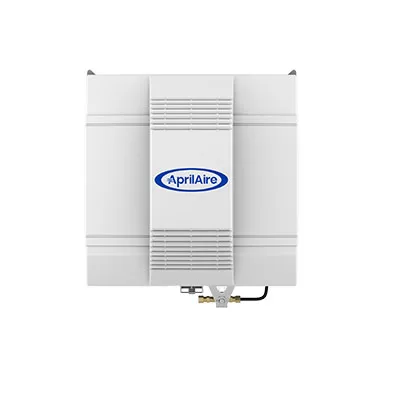
At Air Dynamics, our dedication to indoor air quality includes solutions for maintaining comfortable humidity at home. We install state-of-the-art, fully automatic Aprilaire whole-house humidifiers for Oswego, Yorkville, Naperville, Aurora and Plainfield.
Adding a fully automatic whole-home humidifier to your HVAC system provides 24-hour, perfectly humidified air for every room in your home. Because the whole-home system achieves your desired air moisture throughout the house, you don’t have to rely on portable in-room humidifiers that limit control over humidity levels in single rooms.
The system also has its own water supply, so you don’t always have to remind yourself to keep it filled. System maintenance is extremely low too.
In addition, just as the Illinois winter can be cold, we all know equally well how sweltering the summers can be. Beyond the increasing air moisture, high RH in summer will often make us feel warmer than we are. This can make us run the AC more than we need to.
A de-humidifier removes excess moisture and sends the proper amount of dry air back into circulation. Air Dynamics installs de-humidifiers for indoor-air comfort in Oswego, Yorkville, Naperville, Aurora and Plainfield as well.
Humidifiers Near Me: Contact Us Today
As a community resource for HVAC, Air Dynamics cares about your air comfort and quality in winter. If you’d like to find out more about home humidity or “humidifiers near me” for Oswego, Yorkville, Naperville, Aurora or Plainfield (IL), give us a call at (630) 731-1550!
